Many GIS teams are sitting on more imagery and field data than they can review. New aerial flights arrive before the last set has been fully analyzed. Parcel updates wait in queues. Field observations get stored but rarely revisited. The intent was always to turn that data into decisions, but the manual work of getting there - digitizing features, classifying land cover, reviewing parcels one by one - never quite scales to the size of the archive.
GeoAI is what closes that gap, and in the last 18 months it has moved from research demo to something a working GIS team can use on the platform it already runs.
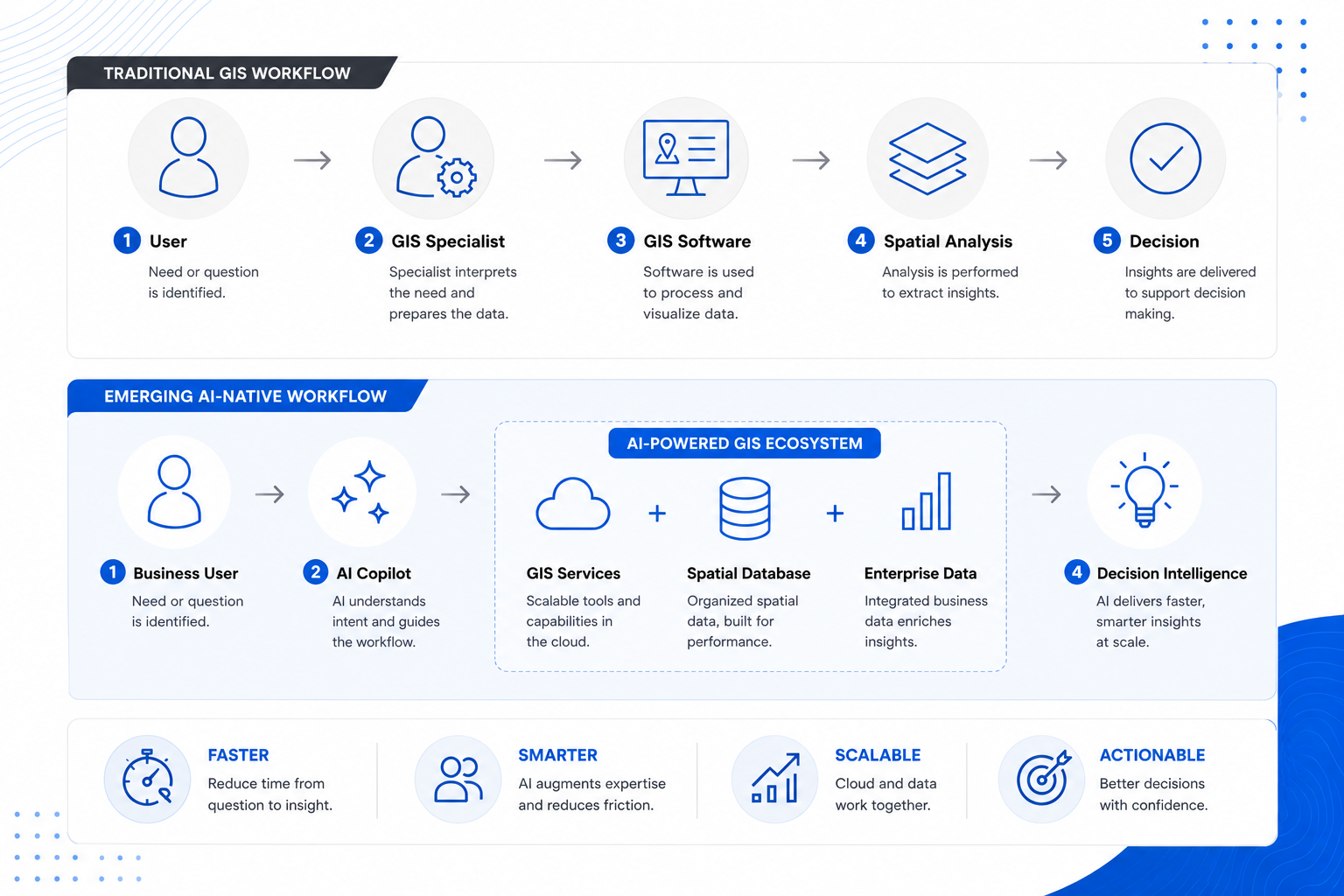
What GeoAI Actually Is
GeoAI is the integration of artificial intelligence, machine learning, and deep learning with GIS. In plain terms, it pairs the spatial analysis you already do in ArcGIS with the pattern-recognition strengths of modern AI. The result is a system that can look at imagery or location data and surface things a person would otherwise have to find by hand, across far more area than a person could ever cover.
Three layers make up the stack:
Pretrained Models
Task-specific models that already know how to extract building footprints, detect roads, classify land cover, or find trees. Esri's Living Atlas hosts more than 100 of them, ready to apply to your own imagery with no training data required.
Foundation Models
Larger models trained to understand the planet broadly rather than one task. This is the fastest-moving area, and the one where the hype most outruns the reality. Worth piloting on the edges, not yet worth betting an entire workflow on.
AI Assistants
The conversational layer Esri is rolling out across its products, letting users describe what they want and lowering the skill floor for routine tasks.
If you run ArcGIS, you are closer to GeoAI than you probably think. It is built into the platform, not bolted on.
What GeoAI is not
It does not replace your GIS team. Models handle the first pass; your people still decide which problem is worth solving, validate the output, and own the result.
Accuracy also is not guaranteed out of the box: a pretrained model built on one region or sensor will not perform identically on yours, so every output needs a human check. And there is no single purchase that "does AI" for you. The value only shows up once the output is wired into a real workflow, dashboard, or decision.
You also don't need a data science team to start. Pretrained, platform-integrated tools have put real capability within reach of teams that could never have afforded a custom build two years ago.
What This Looks Like by Sector
Law Enforcement & Emergency Services
Faster feature extraction and change detection across large areas, freeing analysts and responders to focus on judgment calls instead of manual review.
State & Local Government
An AI first pass on parcel review, land cover, and permit work in hours instead of weeks, with staff validating rather than starting from zero.
Non-Profit & Mission-Driven
Mapping change across millions of acres on a mission budget, so more of the budget goes to the mission itself.
Commercial
Site selection and risk assessment move from instinct and spreadsheets to forecasts that signal where things are headed.
A Three-Question Readiness Check
You do not need an AI strategy to get started. You need one good use case. These three questions tell you whether you have one.
Score two or more yes answers, and GeoAI is worth a serious look right now, not someday.
Where To Start
The most common mistake is starting with the technology rather than a problem worth solving. Pick a task that is single, high-volume, and well-defined, the kind of work your team would call tedious. Check whether a pretrained model already exists for it. Run it against a sample of your own data and have your experts validate the results honestly. Only then decide how to operationalize it: where the output lives, who acts on it, and how it connects to the decision it's meant to inform.
Get A Clear Next Step
Blue Raster runs a no-cost GeoAI readiness assessment: a short scoping call to identify one high-value GeoAI use case for your data, on the GIS platform you already run. You leave with a clear sense of what is feasible, what it would take, and whether it is worth doing - no obligation.
Contact Us Today to Get Started
Blue Raster is an Esri partner that builds mapping applications, cloud deployments, and data visualizations for federal, state and local, non-profit, and commercial teams. GeoAI capability descriptions reflect Esri's documented ArcGIS capabilities as of 2026; specific features and availability vary by release and license.